WebSocket API Overview
Overview
The Hathor WebSocket API enables real-time, bidirectional communication with a full node.
Unlike HTTP APIs, WebSocket connections provide:
- Continuous event streaming
- Low-latency server push updates
- Efficient state synchronization
- Built-in flow control mechanisms
This API is designed for applications that require live data, such as wallets, explorers, and mining clients.
Available Endpoints
The WebSocket API is composed of three specialized endpoints:
| Endpoint | Path | Purpose |
|---|---|---|
| Admin WebSocket | /ws | Wallet events, subscriptions, and metrics |
| Event WebSocket | /event_ws | Reliable event streaming with replay |
| Mining WebSocket | /mining | JSON-RPC mining protocol |
Connection
The WebSocket URL is derived from the full node HTTP base URL:
| HTTP | WebSocket |
|---|---|
https://node.example.com/v1a/ | wss://node.example.com/v1a/ws/ |
Rules:
http→wshttps→wss/ws/is appended to the base path
Message Structure
All messages are JSON objects with a mandatory type field:
{
  "type": "<message_type>"
}
Message types may use namespaced formats:
"stream:history:vertex"
Message Direction
All messages are defined from the server perspective:
| Direction | Meaning |
|---|---|
| Client → Server | Commands / Requests |
| Server → Client | Events / Responses |
Keepalive
Client → Server
{
  "type": "ping"
}
Server → Client
{
  "type": "pong"
}
Capability Discovery
{
  "type": "capabilities",
  "capabilities": ["history-streaming"]
}
Admin WebSocket (/ws)
The Admin WebSocket provides real-time interaction with wallet data, network metrics, and transaction history.
It supports:
- Address-based subscriptions for wallet updates
- Live balance and transaction notifications
- Network statistics streaming
- Transaction history streaming with flow control and acknowledgments
Example Flow
The general connection flow would be:
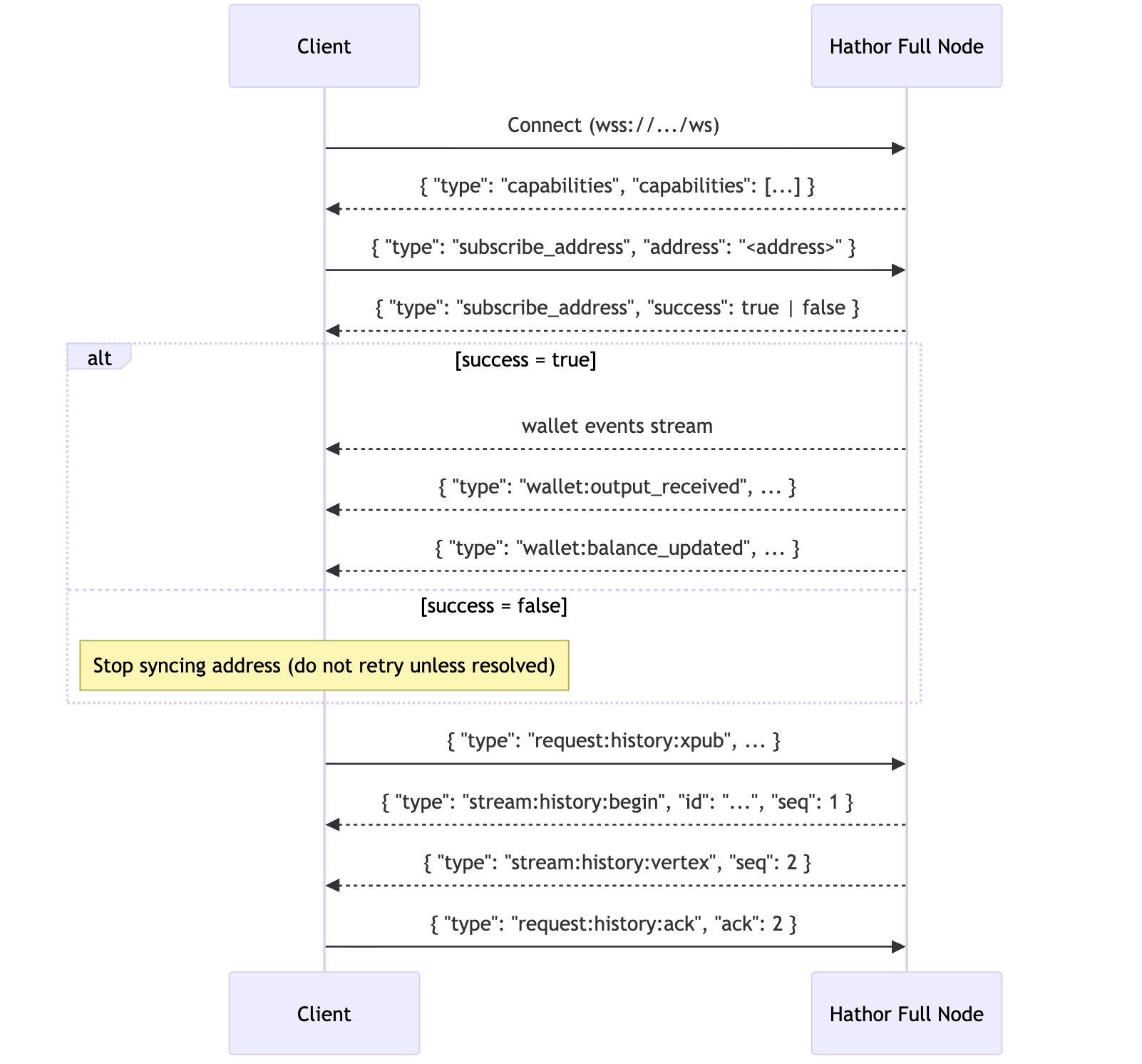
- Connect to
/ws - Receive
capabilities - Subscribe to addresses
- Receive wallet and network events
- Optionally request history streaming
Subscription Example
Subscribe
{
  "type": "subscribe_address",
  "address": "<base58-address>"
}
Unsubscribing
{
  "type": "unsubscribe_address",
  "address": "<base58-address>"
}
Key Events
dashboard:metrics→ Network statisticsnetwork:new_tx_accepted→ New transaction or blockwallet:output_received→ Incoming fundswallet:output_spent→ Outgoing fundswallet:balance_updated→ Balance changeswallet:address_history→ Address activity updates
History Streaming
Supports streaming transaction history via:
request:history:xpubrequest:history:manual
Includes:
- Flow control via
window-size - Acknowledgment via
request:history:ack - Stream lifecycle events (
begin,vertex,end)
Event WebSocket (/event_ws)
The Event WebSocket provides reliable, ordered event streaming from the full node.
It is designed for:
- Processing blockchain events in sequence
- Replaying events from a specific position
- Ensuring delivery reliability through flow control
Features include:
- Event replay using
last_ack_event_id - Strong ordering guarantees
- Sliding window flow control
- Full coverage of node-level events
Example Flow
- Connect to
/event_ws - Send
START_STREAM - Receive events
- Send
ACK - Stop with
STOP_STREAM
Start Streaming
{
  "type": "START_STREAM",
  "last_ack_event_id": null,
  "window_size": 10
}
Acknowledge Events
{
  "type": "ACK",
  "ack_event_id": 100,
  "window_size": 10
}
Stop Streaming
{
  "type": "STOP_STREAM"
}
Event Example
{
  "type": "EVENT",
  "peer_id": "node-1",
  "network": "mainnet",
  "latest_event_id": 123,
  "stream_id": "abc"
}
Event Types
NEW_VERTEX_ACCEPTEDVERTEX_METADATA_CHANGEDVERTEX_REMOVEDREORG_STARTEDREORG_FINISHEDTOKEN_CREATEDNC_EVENTFULL_NODE_CRASHED
Mining WebSocket (/mining)
The Mining WebSocket implements a JSON-RPC 2.0 protocol for interacting with the mining system.
It allows clients to:
- Retrieve block templates
- Submit mined blocks
- Receive updates when templates change
- Continue mining efficiently using optimistic mode
JSON-RPC Format
Request
{
  "jsonrpc": "2.0",
  "id": "1",
  "method": "method.name",
  "params": {}
}
Response
{
  "id": "1",
  "result": {},
  "error": null
}
Methods
mining.refresh
{
  "jsonrpc": "2.0",
  "id": "1",
  "method": "mining.refresh",
  "params": []
}
mining.submit
{
  "jsonrpc": "2.0",
  "id": "1",
  "method": "mining.submit",
  "params": {
    "hexdata": "<block-hex>",
    "optimistic": true
  }
}
Notifications
mining.notify
{
  "method": "mining.notify",
  "params": []
}
Block Template Fields
data: Serialized blockreward: Mining rewardweight: Difficulty targettimestamp_*: Valid time rangeparents: Required referencesheight: Block height
Flow Control
Flow control is implemented using a sliding window mechanism.
Key Concepts
window_size: Maximum unacknowledged messagesack: Last processed message- Server pauses when window is full
Where It Applies
| Endpoint | Usage |
|---|---|
| Admin WebSocket | History streaming |
| Event WebSocket | Event streaming |
Summary
The Hathor WebSocket API enables:
- Real-time blockchain interaction
- Reliable event processing
- Flexible wallet integrations
- Mining protocol support
Deep Dive
For a complete low-level protocol specification: WebSocket Protocol Reference